For Many Caring Relationships, Working as a Care Partner Rather Than Caregiver Is Appropriate
Decades ago, when I began my caregiving life, I just did what I did. I’m not sure I was referred to as anything other than the daughter, the niece, or the mom, and I was too busy to care.
However, as my elders became more dependent, I began to hear myself, at least in medical settings, referred to as “the caretaker.” Somehow, that word made me grind my teeth. My loved ones were not a patch of land. They were not a house. They were not an object. Yet the term “caretaker” brought such images to mind.
As the years went by, however, I slowly began to notice a change in terminology in the clinic and hospital settings. When I accompanied my loved ones to medical appointments, the dreaded “caretaker” was gradually overtaken by “caregiver.”
Yes! That made sense. Caregiving seemed to help restore dignity to the person for whom I cared while describing what I did.
However, with awareness comes change, and there is a new term we’ll all be seeing more of: “care partner.” Care partner implies that the person who is living with the disease and the person providing care are equal and that is as it should be. There are reasons why I don’t see myself using the term care partner exclusively in the near future, but I do expect that in my future articles you will see the term more often.
Why the term makes a difference
I first came across the term care partner in conjunction with Alzheimer’s disease. This, at first glance, would seem to be the last place where this term fits. People with Alzheimer’s need someone to take over their lives, right? The answer, of course, is nothing could be farther from the truth.
Most people who are diagnosed with Alzheimer’s disease or any other type of dementia are just like anyone else with a diagnosis. They see a doctor because they have some symptoms, so, yes there are issues. But the diagnosis doesn’t immediately change them.
There is life after a dementia diagnosis, and that life isn’t any different from the day before, other than the person has had their health issue confirmed. What it doesn’t (or shouldn’t) do is push the person farther into his or her disease.
If this person is fortunate enough to have a life partner, one hopes that this partner doesn’t suddenly turn into a person who immediately takes charge. Supportive couples — and I’m including adult children and even the professionals who are part of the team — are now on the road to figuring out how life is best lived as care partners.
What about when the person has severely impaired cognition?
There will be those who disagree with me, but I have problems with using the term “care partner” as the sole description of a person who provides care for someone living with a disease, disorder, or even temporary injury.
Let’s use Alzheimer’s as an example: A person who receives this official diagnosis will not immediately see a life change, but they will eventually develop debilitating symptoms that, tragically, will rob him or her of the ability to make many decisions. He or she will lose the privilege to drive. Later, this person will lose the ability to write a check or make legal decisions. Even later, he or she will likely lose the ability to use words, to control bowels and bladder, and to swallow.
While everyone should be encouraged to do as much for themselves as possible, this person will have little ability for self-care. Notice that I’m not saying that this person no longer has a say about preferences and wishes, but the actual execution of self-care is extremely limited. Is this person still a care partner, or has the relationship changed to that of caregiver-care receiver?
If this person’s care partner has empathy, education, compassion, and patience, they will continue to tune into what their care partner wants and needs.
There is a difference between partnering with someone who has diabetes or even early or mid-stage Alzheimer’s (or other dementia) and partnering with someone who is still just as much of an individual as before but has become completely dependent on the care of another. The person providing the care needs to be exquisitely tuned in to the nuances of the person living with the disease in order to provide this care in the best way possible, so it’s still a partnership, but there are nuances that differ.
For now, I’ll use both terms. I will use “care partner” whenever I can. I’ve been there with my dad who had dementia caused by surgery, and caring for him was definitely a partnership. However, it was also a responsibility beyond partnering with someone who has an illness or a disease but is still able to make sound decisions. I couldn’t allow my dad to drive when he suddenly decided that he could. I had to say no. I did so as kindly as possible, but I had to be the caregiver, and a firm one at that.
While I will increase my use of the inclusive term care partner, I will likely be using the word caregiver, as well for a long time to come.
Perfect Holiday gifts!
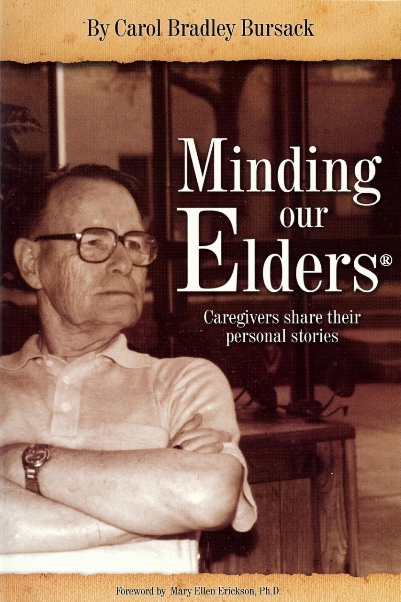
Minding Our Elders: Caregivers Share Their Personal Stories.“I hold onto your book as a life preserver and am reading it slowly on purpose…I don’t want it to end.” …Craig William Dayton, Film Composer
Stay connected with Memoryboard: Designed by caregivers. Memoryboard helps families share reminders, messages, updates, and photos on an easy-to-use screen designed for people with dementia. Peace of mind for families, independence for loved ones.
Leslie Kernisan, MD, MPH, has opened up support! View two free caregiving webinars that can help you help your older parents (and yourself).